Navigating the 2025 Dietary Guidelines: Implications for Medical Nutrition Therapy

The U.S. Department of Agriculture and U.S. Department of Health and Human Services recently released the 2025 Dietary Guidelines for Americans (DGAs).1 The DGAs are updated every 5 years and serve as the cornerstone of nutrition program and policy planning, which in turn can influence school lunch programs, SNAP benefits, and nutrition education to the public.
What’s New in the 2025 Dietary Guidelines for Americans
A central message in the new guidelines is “Eat Real Foods.” Recommended actions include prioritizing nutrient-dense whole foods and limiting ultraprocessed foods, added sugars and refined carbohydrates. In the guidelines, protein and vegetables serve as the foundation for achieving healthy eating patterns.
The new Dietary Food Pyramid is an upside-down version of the previous DGAs released in 2020 (see 2025 inverted pyramid below). Many of the suggestions in the pyramid and guidelines are evidence-based and supported by science. For example, research has demonstrated the negative association between increased consumption of ultraprocessed foods and risk of cardiac disease and mortality.2
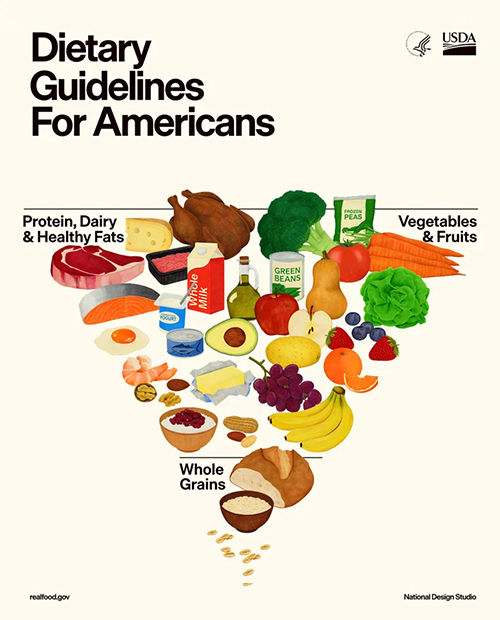
Similarly, the 2025 DGA advice to lower sodium intake is consistent with previous recommendations. A well-recognized dose-response relationship exists between sodium intake and blood pressure, as well as cardiovascular events.3
Areas of Controversy Within the New Dietary Guidelines
However, other aspects of the guidelines are controversial. For example, the new DGAs define healthy fats as any that are in their whole, natural state. This includes both plant and animal-based fats. Use of butter and beef tallow as appropriate alternatives to plant-based fats such as olive and canola oil are allowed despite their higher saturated fat content.
Directives to consume a high-protein diet that includes red meat and full-fat dairy can be challenging to follow while limiting saturated fat intake to less than 10% of total calories.
While the DGAs are intended to promote wellness and prevention of disease, they are also used when providing medical nutrition therapy. The guidelines often serve as the basis for meal planning and diet therapy in patients living with diabetes, heart, and kidney disease. This has direct implications for dietitians and educators in the field of nutrition.
Navigating Conflicting Nutrition Messages in Clinical Practice
Confusion exists about how to incorporate the new DGAs when teaching dietetic students and clinicians involved in providing care for patients. Dietitians are trained to be at the forefront of prescribing diets and providing nutrition counseling to people with complex medical conditions. They must learn how to navigate conflicting messages between the DGAs and those set by the American Heart Association, the Academy of Nutrition and Dietetics, and other healthcare authorities.
The Essential Role of Dietitians in Individualizing Care
Only registered dietitians have the knowledge and expertise to interpret nutrition science and transform it into a nutrition plan that works for patients. This is accomplished in a way that considers patient preferences and beliefs along with their medical condition.
The ability to personalize diet therapy based on a person’s nutritional status, biochemical parameters, and other clinical markers is a skill that distinguishes dietitians and makes them effective. Nutrition monitoring and evaluation of the efficacy of diet therapy, a major component of the nutrition care process, can assure that patients receive information about how to make the right choices for better outcomes.
Future dietitians will be instrumental in this process. The dietitians of tomorrow require a unique skill set that bridges the gap between evidence-based guidelines and the needs of their patients and clients in a changing environment. Learning how to apply critical thinking to formulate nutrition care plans is central to this.
Future dietitians will also need to be flexible and responsive to the lifestyle and needs of their patients or clients. Despite the confusion and criticism generated by the new DGAs, an opportunity exists for those training to be dietitians. More than ever, their expertise is necessary to tackle the controversies that are sure to continue as we move forward over the next 5 years.
References
- U.S. Department of Agriculture and U.S. Department of Health and Human Services. Dietary Guidelines for Americans, 2025-2030. (10th Ed.) https://DietaryGuidelines.gov
- Lane MM, Gamage E, Du S, Ashtree DN, McGuinness AJ, Gauci S, et al. Ultra-processed food exposure and adverse health outcomes: umbrella review of epidemiological meta-analyses BMJ. 2024;384:e077310. doi:10.1136/bmj-2023-077310
- Filippini T, Malavolti M, Whelton PK, Naska A, Orsini N, Vinceti M. Blood Pressure Effects of Sodium Reduction: Dose-Response Meta-Analysis of Experimental Studies. Circulation. 2021;143(16):1542-1567. doi: 10.1161/CIRCULATIONAHA.120.050371
ABOUT THE AUTHOR
Kathy Prelack, PhD, RD, LDN, is a registered dietitian who is an associate professor at Simmons University and an adjunct associate professor at Tufts University. Her primary academic focus is on clinical nutrition, medical nutrition therapy, and interprofessional learning. Dr. Prelack’s research interests include energy expenditure and protein metabolism following burn injury and methods of body composition analysis in a clinical setting.
In addition, Dr. Prelack is Director of Clinical Nutrition at Shriners Hospitals for Children, a pediatric burn and surgical specialty hospital, where she has worked for more than 30 years. She enjoys mentoring students, interns, and emerging investigators interested in pediatric critical care and clinical research. She is active in international outreach promoting the importance of early nutrition in children with burn injuries.
Dr. Prelack is a member of the Academy of Nutrition and Dietetics and the American Society of Parenteral and Enteral Nutrition. She is a coauthor for Advanced Medical Nutrition Therapy, (2nd Ed.), scheduled for release in July 2026.